Monitor
Connected home devices and weekly check-ins capture blood pressure, oxygen, weight, temperature, symptoms, and medication adherence — compared against each senior’s own baseline.
Community senior health · A program of ICRBI
Digital Twin Health 4.0 pairs connected home devices, weekly check-ins, and caregiver observations with a longitudinal digital profile, so risk signals surface earlier and families, community partners, and clinicians can respond sooner.
A program of ICRBI — guided by the SPELL Impact framework
A program of the Islamic Center for Research and Business Incubator (ICRBI), San Diego, California.
The problem · Why now
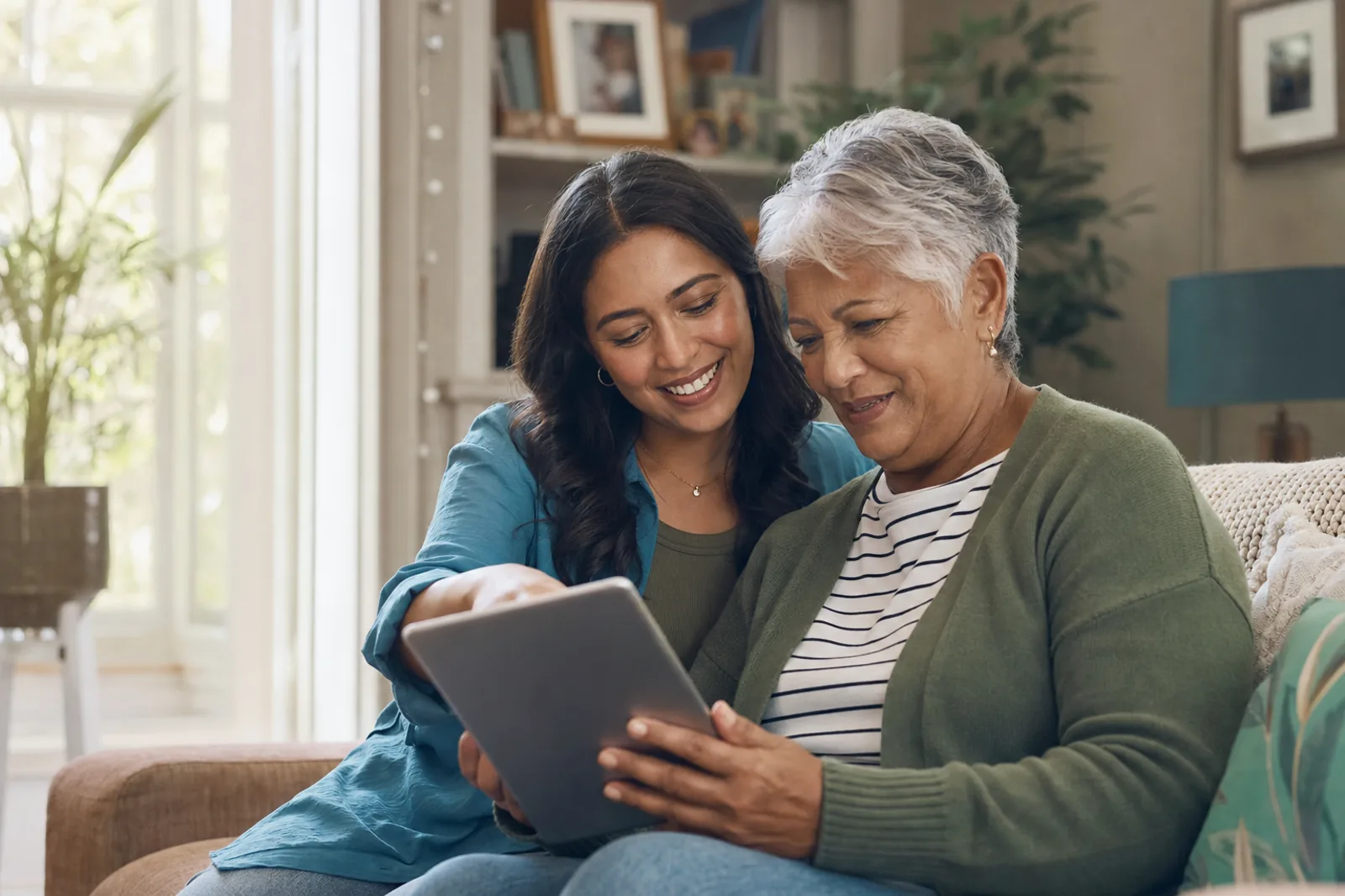
Care for older adults with chronic disease often happens in disconnected intervals: a clinic visit, a medication change, a quiet period at home, then an urgent episode. The most important changes frequently happen between formal encounters, where clinics have limited visibility and families are left to interpret symptoms alone.
The need is large and growing. Chronic diseases are the leading drivers of illness, disability, death, and healthcare costs in the United States, and 90% of the nation’s annual healthcare expenditures are for people with chronic and mental health conditions (CDC).
Family caregivers are under growing strain. AARP and the National Alliance for Caregiving reported in 2025 that 63 million Americans provide ongoing care for an adult or child with a complex condition — nearly one in four adults — an increase of 20 million since 2015 (AARP).
How the program works
A human-reviewed model that starts simple and grows with each community.
Connected home devices and weekly check-ins capture blood pressure, oxygen, weight, temperature, symptoms, and medication adherence — compared against each senior’s own baseline.
Caregivers get structured visibility into readings, missed tasks, and clear escalation guidance — with reminders and nonclinical navigation that reduce the guesswork of caring at home.
Care navigators link seniors to telehealth, primary care, and community resources, and route curated summaries — not raw device feeds — to clinical partners.
Each cohort produces a monthly impact report — engagement, escalations, and outcomes — so partners and funders can see what is working and refine the model.
The framework behind the program
Monitor, Support, Connect, and Learn are how this program runs. SPELL Impact is what they are accountable to — the commitments every ICRBI program shares, and the standard this pilot will be judged against.
We look at symptoms, vitals, daily function, medications, personal goals, and life circumstances together — not one number at a time.
Delivered by MonitorWe turn that picture into clear, clinically reviewed next steps that fit the person in front of us. Every reading is compared against that senior’s own baseline, not a population average.
Delivered by Monitor + SupportWe work with the person, their caregivers, and the places they already trust — not around them.
Delivered by SupportWe connect people to clinical care and to food, transport, benefits, and support — and we confirm they got there. A referral stays open until a partner confirms the senior actually received help.
Delivered by ConnectWe measure whether it worked, report it openly, and change what does not. Every measure is stratified by language, neighborhood, and digital access, so we can see who the program is not yet reaching.
Delivered by Learn & ReportReadings and patterns are reviewed by a registered nurse or trained care navigator. Our technology helps prioritize and summarize — it does not diagnose. Licensed clinicians make all clinical decisions, and a risk score is never presented as a diagnosis. How we govern data and algorithms →
Who it helps
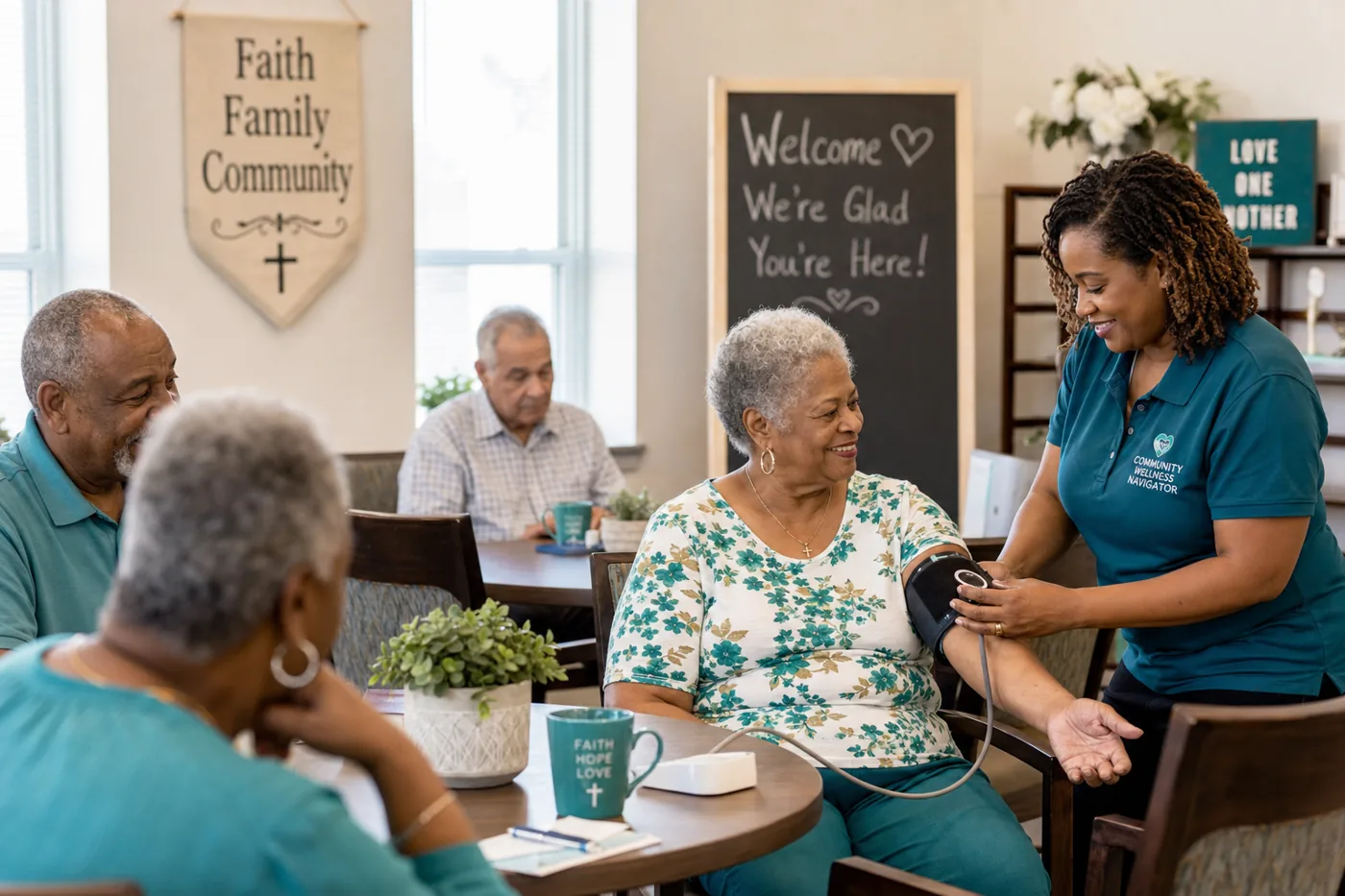
Older adults managing hypertension, diabetes, heart or lung disease, kidney disease, autoimmune conditions, frailty, or recovery after a hospital stay.
Adult children, spouses, and family members who need clearer visibility, reassurance, and guidance on when a change needs attention.
Primary care, geriatrics, cardiology, pulmonology, and rheumatology teams who want between-visit visibility without noisy dashboards.
Trusted community spaces that can host wellness, caregiver support, and navigation in familiar, culturally welcoming settings.
The starting point
Operationally realistic, measurable, and fundable — built to prove value before scaling.
Identify older adults with chronic disease, frailty risk, recent discharge, caregiver dependence, or access barriers. Screen eligibility and gather consent.
Provide a connected-device kit — blood pressure cuff, pulse oximeter, scale, thermometer — with onboarding and caregiver setup.
Run weekly symptom check-ins, monitor readings against baseline, and provide care navigation with human-reviewed alerts and escalation.
Deliver a monthly report on engagement, readings captured, escalations, and outcomes to partners and funders — and refine for the next cohort.
Technology architecture
Home vitals and wearables capture daily and weekly signals.
Timestamped readings, history, consent, and provenance in one record.
Baseline-deviation and risk tiers prioritize what needs attention.
Human triage, escalation notes, and clinic summaries.
The data model is built to align with FHIR, which provides standardized resources and APIs for exchanging health information — including patient and observation data that can represent home vitals (eCQI Resource Center, HL7 FHIR PGHD Implementation Guide).
Alerts are curated and risk-tiered, then reviewed by an RN or care navigator. The program performs no autonomous diagnosis and recommends no medication changes — it organizes signals and supports human decisions.
Designed around HIPAA-aligned workflows, business associate agreements, role-based access, consent management, and audit logs — with care taken to keep data minimal and purposeful.
Human digital twins are described as patient-specific virtual representations updated with real-world data to support prediction and personalized care; many remain emerging and need further validation (Nature Digital Medicine, PMC review).
Partnership pathways
Each pathway starts with a 90-day pilot and a clear, measurable goal.
Host a community wellness and caregiver-support program in trusted, familiar spaces with language and cultural access.
Add between-visit visibility and care-navigation support, with curated summaries that fit clinical workflows.
Co-design a feasibility study on monitoring, caregiver value, and baseline-deviation signals, with de-identified analytics.
Integrate validated devices and platforms into a senior-friendly, human-reviewed monitoring model.
Sponsor community cohorts and receive monthly impact reporting on engagement, escalations, and outcomes.
Clinic compliance resources
Built for clinic administrators, billing teams, and care coordinators preparing a Digital Twin Health 4.0 pilot.
Clinic handout
A concise clinic-facing handout covering RPM readiness, provider enrollment, telehealth consent, Q3014/T1014 guardrails, and device funding limitations for California implementation.
The companion packet turns the SOP and handout into an internal launch guide: intake checklist, role assignments, billing controls, consent scripts, escalation routing, and pre-claim review steps.
Open onboarding packetBased on the California Department of Health Care Services Telehealth FAQ and related Medi-Cal guidance. Clinics should confirm final coding, enrollment, and claim rules with their compliance advisor and payer before launch (DHCS Telehealth FAQ).
What we measure
SPELL Impact requires reporting at three levels. Figures appear once the pilot reports — we publish no number our measurement can substantiate.
Individual
—
Seniors reporting progress on the goal they chose themselves, in their own words
Reported at 90 days and end of pilot
Community
—
Referrals confirmed complete by a partner — not just sent
Reported monthly in the cohort impact report
System
—
Median time from a flagged signal to a human reaching the senior
Reported monthly
Weekly check-in completion and device adherence.
Reliable home vitals collected per participant.
Alert response time and escalation completion.
Reductions in avoidable, non-urgent visit burden.
Self-reported confidence and perceived support.
Telehealth and follow-up appointments completed.
Senior and caregiver satisfaction with the program.
Enrollment across language, neighborhood, and access barriers.
Digital Twin Health 4.0 supports clinicians and caregivers. It does not replace doctors, nurses, urgent care, emergency services, or 911. The program provides monitoring and care coordination — it performs no autonomous diagnosis and recommends no medication changes.
In an emergency, or if you believe someone is in danger, call 911 or go to the nearest emergency department.
Start a conversation
Whether you run a senior or faith-based center, a clinic, a research group, or a foundation, we would welcome a conversation about a 90-day pilot or a collaboration.
Start a pilot conversationTemporary public hosting is in place until ICRBI completes domain registration.